
Introduction
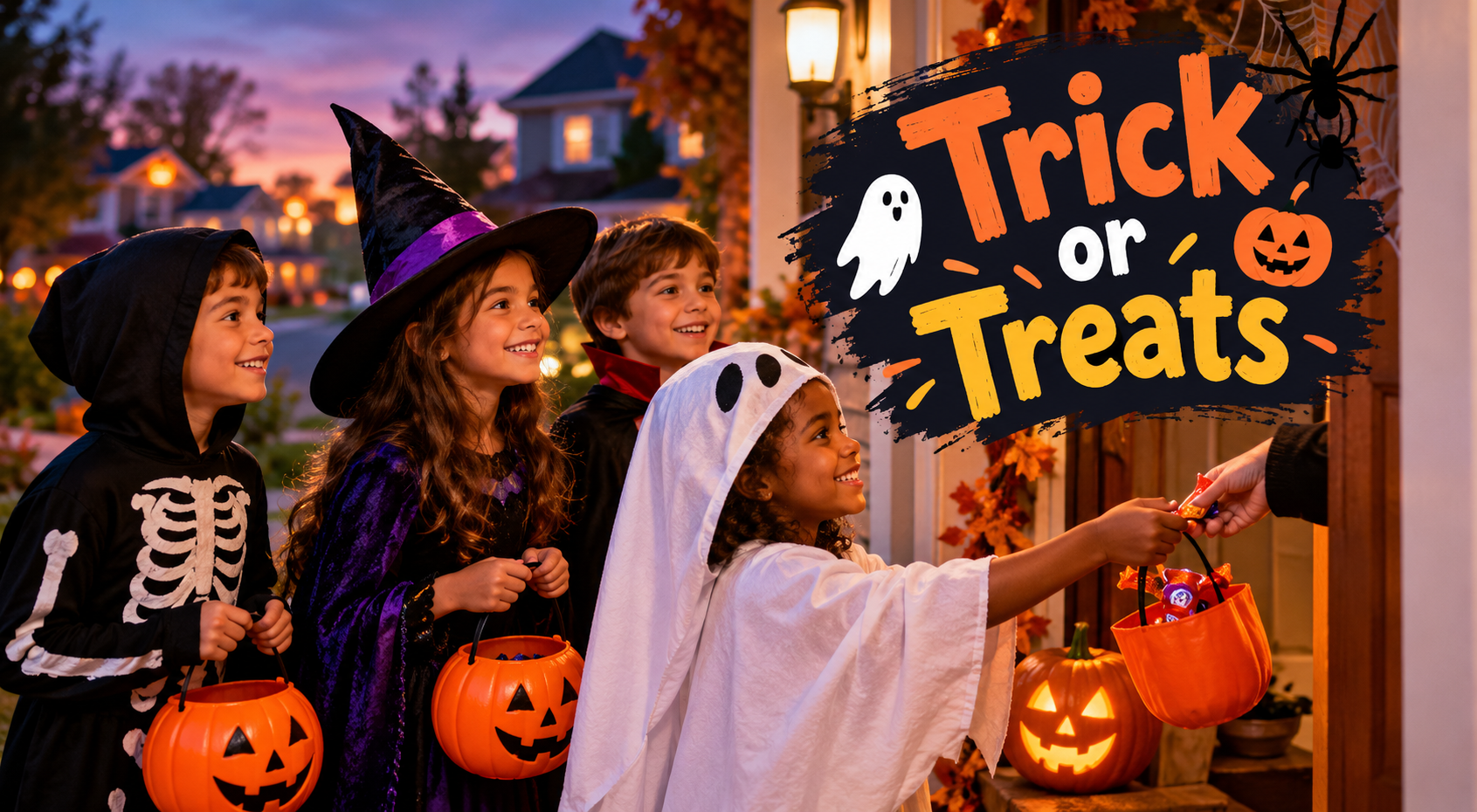
Trick or treats is a fun way to bring real-world English into the classroom while helping students learn vocabulary they may hear in American movies, conversations, and Halloween celebrations. Instead of studying isolated words, students can learn expressions such as go trick-or-treating, wear a costume, ring the doorbell, hand out candy, and carve a pumpkin in a meaningful context. Read more about Halloween traditions in https://en.wikipedia.org/wiki/Halloween
Halloween is celebrated on October 31, and many American children celebrate by wearing costumes, visiting houses in their neighborhoods, and asking for candy by saying “Trick or treat!” The tradition has a long history, but today it is mostly associated with costumes, candy, decorations, parties, and fun.
For teachers, Halloween is also an excellent opportunity to combine Halloween vocabulary, reading comprehension, grammar, and interactive learning. For independent learners, the activities below provide a simple way to practice English and check understanding immediately.
Halloween Vocabulary for A2–B1 Students
Before starting the activities, let’s look at some useful words and expressions.
| Word or expression | Meaning |
|---|---|
| costume | special clothes you wear to look like another person or character |
| candy | sweet food, especially popular with children |
| pumpkin | a large orange vegetable often used for Halloween decorations |
| jack-o’-lantern | a pumpkin with a face cut into it |
| ghost | the spirit of a dead person in stories or popular culture |
| witch | a person, usually a woman in stories, who uses magic |
| haunted house | a house believed to have ghosts |
| scary | making you feel afraid |
| spooky | strange and a little frightening |
| doorbell | a bell that you press when you visit someone’s home |
| neighborhood | the area where people live |
| treat | something nice that you receive, especially food or candy |
| trick | a joke or action used to surprise or fool someone |
| trick-or-treating | the Halloween activity of visiting houses to ask for candy |
Useful Halloween expressions
Students should learn these expressions as complete chunks rather than as individual words:
- wear a costume
- dress up
- go trick-or-treating
- ring the doorbell
- knock on the door
- ask for candy
- give out candy
- carve a pumpkin
- decorate the house
- tell a scary story
- have a Halloween party
For example:
We dressed up as superheroes and went trick-or-treating.
My neighbors gave out candy to the children.
She carved a pumpkin with a funny face.
These expressions are especially useful for students who want to move from memorizing vocabulary to using English naturally.
A Short Reading: Halloween Night
Read the text before doing the quiz.
Trick or treats: A Halloween Night in the Neighborhood
It was Halloween night, and Emma was getting ready to go out with her friends. She put on her witch costume and checked her bag. It was empty, so she was ready to fill it with candy.
-------- Continua após a publicidade --------
Outside, the neighborhood looked different. Some houses had orange lights, fake spiders, and scary decorations. A few people had carved pumpkins and placed them near their front doors.
Emma and her friends walked from house to house. At each house, they knocked on the door or rang the doorbell and said, “Trick or treat!”
Most people smiled and gave them candy. One neighbor gave them chocolate, while another gave them small bags of candy. At one house, the lights were off, so the children decided not to knock.
After an hour, Emma’s bag was full. She and her friends went home, counted their candy, and talked about their favorite costumes.
It was a simple Halloween night, but everyone had fun.
Reading Comprehension Quiz
The reading can be turned into an H5P Question Set. H5P’s Question Set allows teachers to combine question types such as multiple choice, fill-in-the-blanks, and other interactive questions in the same activity.
This small step helps students connect meaning with context instead of translating every word individually.
Grammar Focus: Simple Past in a Halloween Story
The reading uses the Simple Past because it tells us about events that happened and finished in the past.
Look at these examples:
- Emma put on her costume.
- She checked her bag.
- Her friends walked from house to house.
- They knocked on the doors.
- People gave them candy.
- Emma went home.
The basic structure is:
Subject + past verb + complement
Emma checked her bag.
For regular verbs, we usually add -ed:
- walk → walked
- knock → knocked
- count → counted
- decorate → decorated
But some very common verbs are irregular:
- go → went
- give → gave
- have → had
- see → saw
- put → put
For negative sentences, use didn’t + base verb:
They didn’t knock on the door.
Not:
They didn’t knocked on the door. ❌
For questions, use Did + subject + base verb:
Did Emma wear a costume?
Not:
Did Emma wore a costume? ❌
If you want a deeper explanation and more practice, continue with the MyESLFriends guide to Simple Past.
Grammar extension
Add these three sentences to the same activity:
- Emma __________ her bag before she went outside. (checked)
- Her friends __________ from house to house. (walked)
- They __________ candy from the neighbors. (got)
This gives students a small amount of Simple Past practice without taking the focus away from vocabulary.
Optional B1 challenge
For stronger students, replace the isolated sentences with short contexts:
Emma wore a __________ because she wanted to look like a witch.
The children rang the __________ and waited for someone to open the door.
The house looked __________ because it had fake spiders and dark lights.
This version requires students to understand the sentence rather than simply recognize the vocabulary.
Watch and Learn: Halloween in American Culture
After the reading activities, give students a short listening task.
Watch “Bet You Didn’t Know: Halloween” from HISTORY. The video introduces the history behind Halloween traditions and the “tricks and treats” associated with the holiday.
Before watching
Ask students:
- What Halloween words do you already know?
- Why do you think people wear costumes?
- What do children usually receive when they go trick-or-treating?
While watching
Ask students to listen for these words:
- Halloween
- costumes
- candy
- tricks
- treats
- history
After watching
Students can answer:
1. Which Halloween tradition did you recognize in the video?
2. Which new word did you learn?
3. What surprised you about Halloween?
For A2 students, allow short answers. B1 students can answer in complete sentences.
Halloween Vocabulary: American English Notes
Students learning American English may notice a few words that are especially common in Halloween contexts.
Candy vs. sweets
In American English, candy is the usual word for sweet foods such as chocolate, gummies, and other sugary treats.
The kids collected a lot of candy.
In British English, sweets is commonly used instead.
Both are correct, but if the goal is American English, candy is the word students are most likely to hear in this context.
Trick or treat vs. trick-or-treating
These expressions are related but have different uses.
“Trick or treat!” is what children traditionally say when someone opens the door.
The children shouted, “Trick or treat!”
Trick-or-treating is the activity itself.
We went trick-or-treating last Halloween.
This distinction is useful because students often learn the two expressions together but may not know how they work grammatically.
A Simple Classroom Challenge
After the H5P activities, ask students to create their own Halloween sentence using at least three words from the lesson.
For example:
Last Halloween, I wore a vampire costume and went trick-or-treating with my friends.
Or:
We decorated the house with pumpkins and scary ghosts.
For B1 students, make the challenge slightly harder:
Write three sentences about a Halloween night. Use at least two Simple Past verbs and four Halloween vocabulary words.
This turns passive vocabulary recognition into active language use.
Tips for Teachers
These activities can work as a complete 30–45 minute lesson or as individual activities during a Halloween unit.
For A2 students
Keep the vocabulary list visible and allow students to use the reading as support. Focus on recognition, meaning, and short sentences.
For B1 students
Ask students to explain their answers, retell the reading, or create new sentences with the vocabulary. You can also remove the word bank from the second activity to make it more challenging.
For self-study students
Complete the reading first, then try the H5P activities without looking at the vocabulary list. After checking the answers, return to the words you missed and write one original sentence for each.
The goal is not simply to get a high score. The goal is to remember the words well enough to use them later.
Conclusion
Trick or treats can be much more than a seasonal topic. Halloween gives English learners a memorable context for learning everyday vocabulary, practicing reading comprehension, and reviewing grammar through meaningful sentences.
With a short reading, a focused vocabulary list, and three H5P activities, students can practice the language in different ways without feeling that they are simply doing another grammar worksheet. Teachers can use the activities separately or combine them into a complete Halloween lesson, while independent learners can work through the material at their own pace.
The most important step is to move beyond recognition. After learning words such as costume, candy, pumpkin, treat, and neighborhood, students should use them in their own sentences and conversations.
So this Halloween, don’t just learn the words. Use them, play with them, and have fun with English.
Frequently Asked Questions
1. What is “trick or treat” in American English?
“Trick or treat” is a traditional Halloween expression. Children say it when they visit homes on Halloween night to ask for candy or other treats.
2. What does trick-or-treating mean?
Trick-or-treating is the Halloween activity of going from house to house, usually in costume, and asking for candy by saying “Trick or treat!”
3. What Halloween vocabulary should English learners know?
Some useful Halloween words for A2–B1 students include costume, candy, pumpkin, ghost, witch, treat, scary, spooky, doorbell, neighborhood, haunted house, and jack-o’-lantern.
4. How can teachers use Halloween activities in an ESL class?
Halloween activities can combine vocabulary, reading, listening, speaking, and grammar. Teachers can use short texts, quizzes, sentence-completion tasks, games, and interactive H5P activities to make practice more engaging.
5. What grammar can students practice with Halloween vocabulary?
The Simple Past works particularly well because students can talk about what they did last Halloween, describe a Halloween story, or discuss traditions from the past. For example: “We dressed up,” “We went trick-or-treating,” and “People gave us candy.”
More English Practice
If you enjoyed this lesson, explore more English games and interactive activities on MyESLFriends and continue practicing vocabulary and grammar in context.


