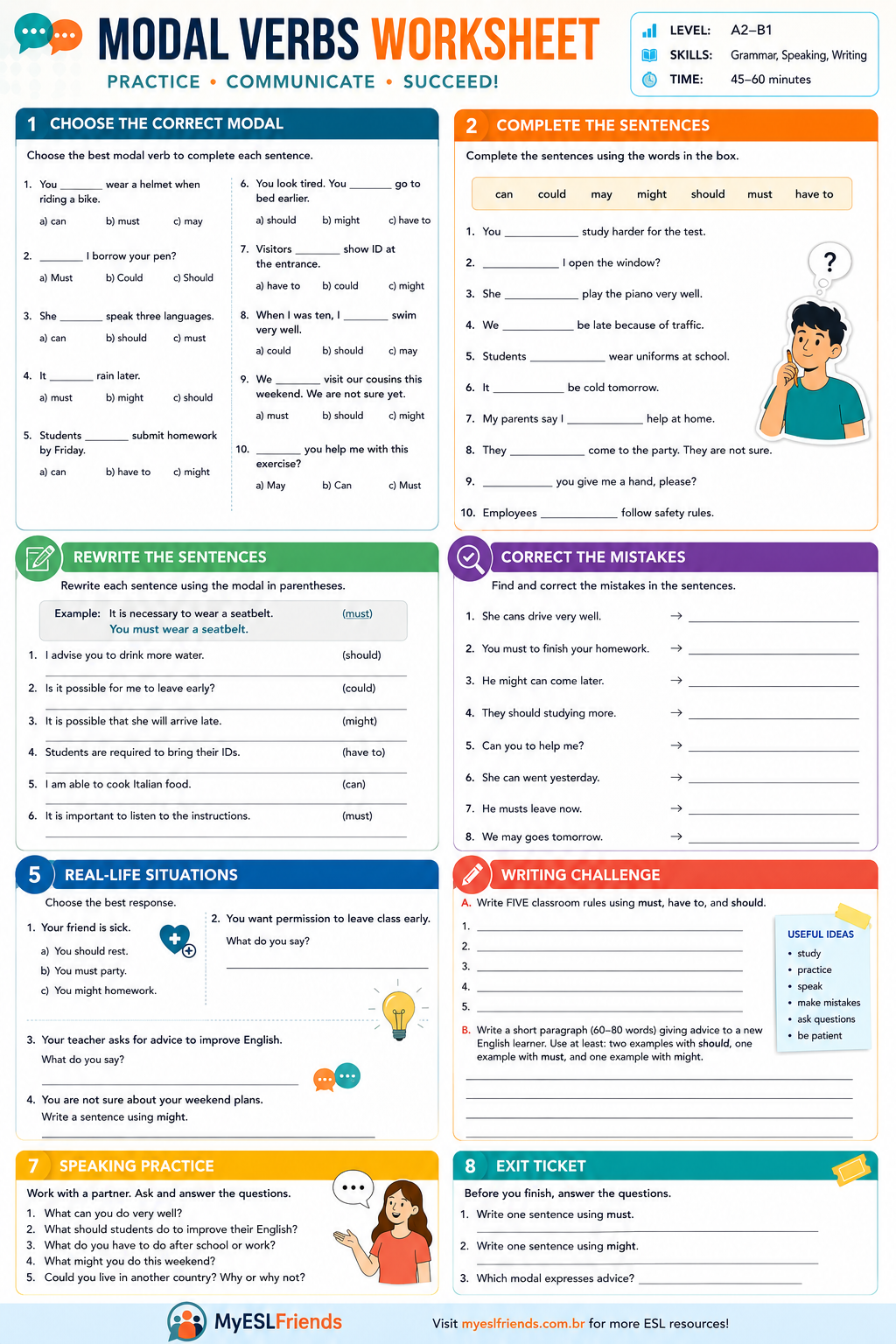
Introduction
Modal verbs are essential for everyday communication in English. They help learners express ability, permission, advice, obligation, possibility, and probability.
This Modals Worksheet offers ESL teachers a complete set of classroom-ready activities designed to help students understand both meaning and form. The material includes explanations, examples, printable exercises, interactive activities, speaking tasks, and lesson ideas that can be used in face-to-face, hybrid, or online classes.
In this article, students will practice common modal verbs such as:
- can
- could
- may
- might
- must
- have to
- should
Whether you need a quick grammar review or a full lesson plan, these free printable activities provide meaningful practice for A2–B1 learners.
Key Takeaways
✔ Learn the most common functions of modal verbs.
✔ Practice modal verbs through printable and interactive activities.
✔ Explore ready-to-use classroom tasks for speaking, writing, listening, and grammar.
✔ Discover practical ideas for mixed-level ESL classes.
✔ Download a free printable Modals Worksheet PDF.
-------- Continua após a publicidade --------
What Are Modal Verbs?
Modal verbs are special auxiliary verbs that add meaning to the main verb. They express ideas such as:
- ability
- permission
- advice
- obligation
- possibility
- probability
Unlike regular verbs, modal verbs follow specific grammar rules.
Examples:
- She can speak Spanish.
- You should study more.
- We might travel next month.
- Students must wear uniforms.
The basic structure is:
Modal Verb + Base Verb
Examples:
✔ You should study.
✔ They can swim.
✔ She might arrive late.
Modal Verbs Functions Chart
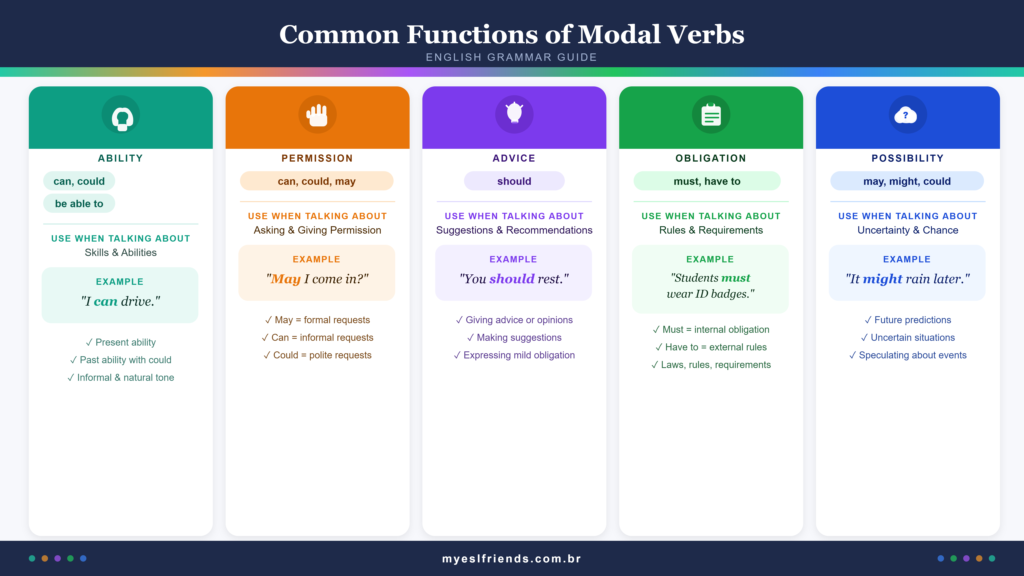
Teacher Tip: Encourage students to identify the meaning first and only then choose the modal verb.
Why Do ESL Students Struggle with Modal Verbs?
Modal verbs are often challenging because one modal can express different meanings depending on context.
For example:
could may express:
- past ability
- polite requests
- possibility
Examples:
- I could swim when I was six. (past ability)
- Could I borrow your pen? (polite request)
- It could snow tonight. (possibility)
This overlap frequently causes confusion in both speaking and writing.
Common Learner Errors
Many students make similar mistakes when learning modals.
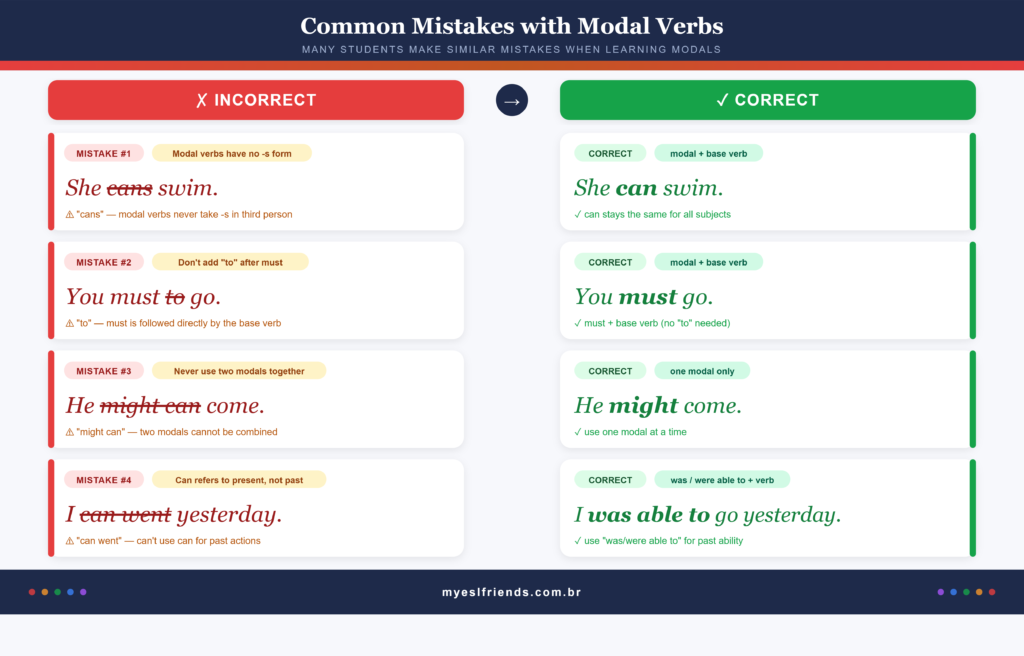
Teacher Tip
Encourage students to always check:
Is the verb after the modal in the base form?
Grammar Focus: Modal Verbs Rules
Modal verbs behave differently from regular verbs.
Rule 1: No -s in the Third Person
✔ She can drive.
❌ She cans drive.
Rule 2: Use the Base Verb
✔ They should study.
❌ They should studies.
❌ They should studying.
Rule 3: No “to” After Core Modals
✔ You must leave now.
❌ You must to leave now.
Rule 4: Questions and Negatives Do Not Need Do/Does
Questions
✔ Can you help me?
✔ Should we start?
Negatives
✔ He can’t stay.
✔ You shouldn’t worry.
Pronunciation Focus
Modal verbs are frequently pronounced in their weak forms during natural speech.
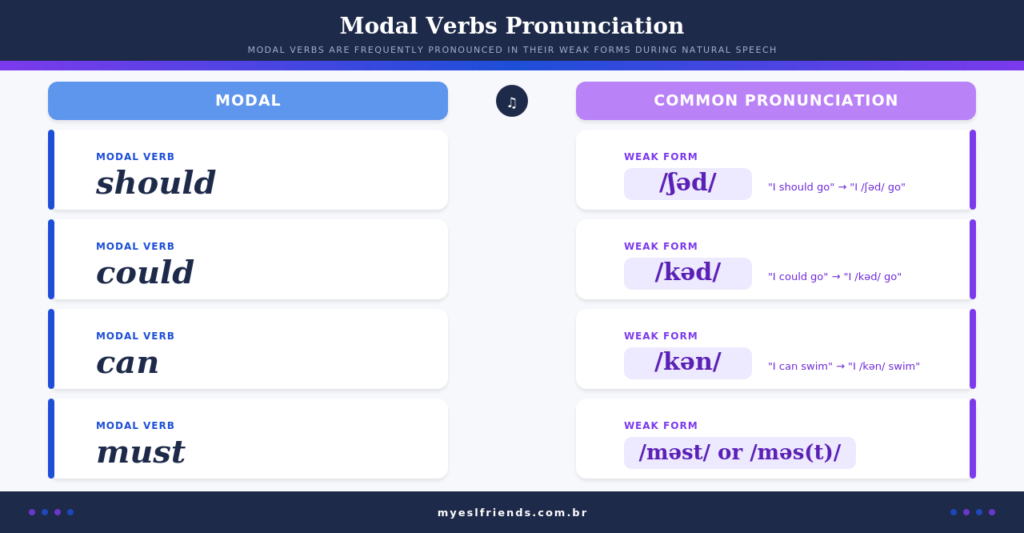
Connected Speech Examples
- You should’ve told me.
- I could’ve helped you.
- She might’ve forgotten.
To learn more about this grammar topic, check out our article Connected Speech in English.
Pronunciation Challenge
Listen and repeat:
- You should study more.
- He could help us.
- They might arrive late.
- She must finish today.
Modals Worksheet Learning Objectives
By the end of these activities, students will be able to:
- identify the correct modal according to meaning;
- distinguish between advice, obligation, permission, and possibility;
- use modal verbs accurately in affirmative, negative, and interrogative sentences;
- communicate using modal verbs in real-life situations.
Skills Covered
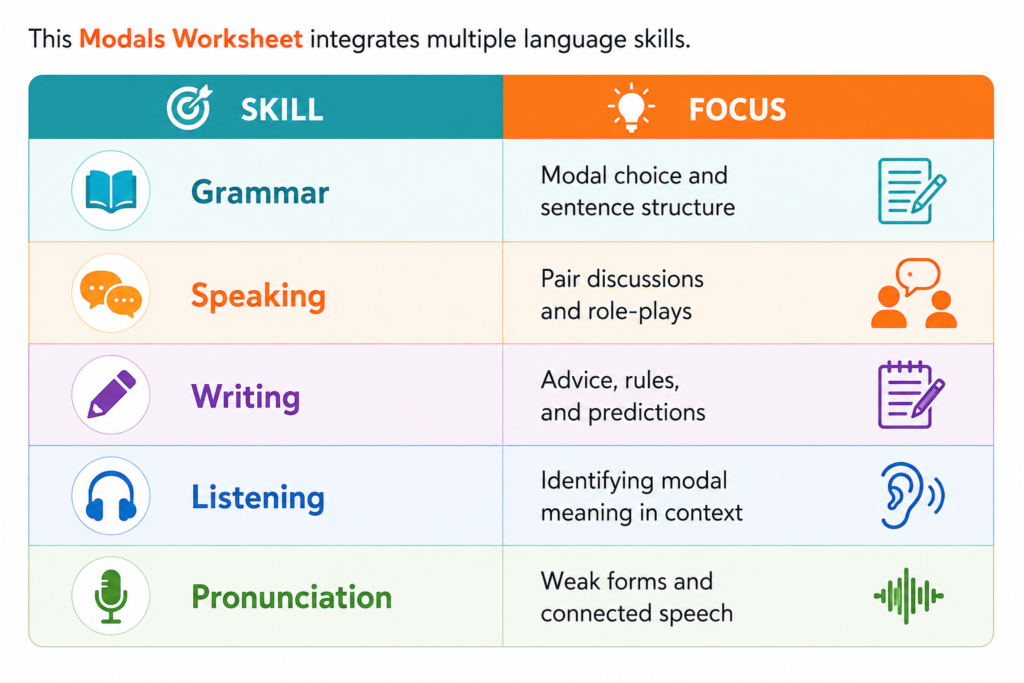
How to Introduce This Worksheet in Under Five Minutes
Step 1 (1 minute)
Review the concept:
Modal Verb + Base Verb
Step 2 (1 minute)
Write two examples on the board:
- You should sleep more.
- Students must wear uniforms.
Ask students:
What meaning does each sentence express?
Step 3 (1 minute)
Students complete two sample sentences individually.
Step 4 (1 minute)
Students compare answers with a partner.
Sentence stem:
“I chose ______ because ______.”
Step 5 (1 minute)
Review answers and highlight one grammar rule.
Example:
Remember: modals never take -s.
Ready to Practice?
In the next section, students will explore printable exercises, interactive H5P activities, speaking challenges, listening tasks, and real-life communication activities using modal verbs.
Interactive ESL Activities for Teaching Modal Verbs
The following activities are designed for A2–B1 ESL learners and can be used as classroom practice, homework, review, or assessment.
Exercise 1 – Choose the Correct Modal
Choose the best modal verb to complete each sentence
Exercise 2 – Complete the Sentences
Exercise 3 – Rewrite the Sentences
Rewrite each sentence using the modal verb in parentheses.
Example
It is necessary to wear a seatbelt.
(must)
→ You must wear a seatbelt.
- I advise you to drink more water.
(should)
- Is it possible for me to leave early?
(could)
- It is possible that she will arrive late.
(might)
- Students are required to bring their IDs.
(have to)
- I am able to swim very well.
(can)
Exercise 4 – Correct the Mistakes
Correct the following sentences.
- She cans drive very well.
- You must to finish your homework.
- He might can come later.
- They should studying more.
- Can you to help me?
- She can went yesterday.
- He musts leave now.
- We may goes tomorrow.
Exercise 5 – Real-Life English
Choose the best response.
Situation 1
Situation 2
You want permission to leave class early.
What do you say?
Situation 3
Your teacher asks for advice to improve speaking skills.
What do you say?
Situation 4
You are not sure about your weekend plans.
Write a sentence using might.
Listening Challenge
Ask students to listen and choose the correct answer.
Audio Script 1
“You should take an umbrella today.”
Why?
a) It is raining.
b) It is sunny.
c) It is snowing.
Audio Script 2
“Students must wear their ID badges.”
What does must express?
a) Advice
b) Obligation
c) Possibility
Audio Script 3
“We might travel next month.”
Is the trip certain?
a) Yes
b) No
Audio Script 4
“Could I borrow your laptop?”
What is the speaker doing?
a) Giving advice
b) Asking permission
c) Expressing ability
Audio Script 5
“I could swim when I was six.”
What does could express?
a) Past ability
b) Permission
c) Advice
Speaking Challenge
Work with a partner.
Ask and answer the questions.
- What can you do very well?
- What should students do to improve their English?
- What do you have to do after school or work?
- What might you do this weekend?
- Could you live in another country? Why or why not?
Writing Challenge
Task 1
Write five classroom rules using:
- must
- have to
- should
Example:
Students must arrive on time.
Task 2
Write a short paragraph (60–80 words) giving advice to a new English learner.
Use at least:
- two examples with should
- one example with must
- one example with might
Pronunciation Challenge
Read the sentences aloud.
- You should study more.
- She could help us.
- They might arrive late.
- Students must wear uniforms.
- Can you help me?
Teacher focus:
✔ weak forms
✔ sentence stress
✔ connected speech
Interactive Activities
Activity 1
Modal Verbs Functions
Activity 2
Instructions
Activity 3 – Writing activity
H5P Activity 4 – Mark the Words
H5P Activity 5 – Find the Mistake
Activity 6 – MULTIPLE CHOICE – Branching Scenario
Situation
You are a new student in an American school.
Real-Life English
Exit Ticket
Before leaving class, answer:
- Write one sentence using must.
- Write one sentence using might.
- Which modal expresses advice?
How to Differentiate This Modals Worksheet for Mixed-Level ESL Classes
Teaching mixed-level classes can be challenging, but modal verbs lend themselves well to differentiation. The key is to maintain the same learning objective while adjusting the level of support.
This worksheet can easily be adapted for A1 to C1 learners.
Easy Mode (A1–A2)
Beginning learners benefit from additional scaffolding.
Suggested Support
- provide a word bank;
- offer two answer choices per item;
- use sentence starters;
- include visual cues when possible.
Example Word Bank
can – can’t – should – must – might
Sentence Starters
- Students must…
- I can…
- You should…
- We might…
Teacher Focus
✔ understanding meaning
✔ using modal + base verb
✔ avoiding common grammar mistakes
Standard Mode (A2–B1)
Intermediate learners should begin making independent choices.
Suggested Activities
- open-ended gap-fill exercises;
- short dialogues;
- pair discussions;
- guided writing tasks.
Pair Check Questions
Students should explain their choices using prompts such as:
“I chose must because it is a rule.”
“I chose might because the speaker is not sure.”
Teacher Focus
✔ meaning selection
✔ grammatical accuracy
✔ oral communication
Challenge Mode (B2–C1)
Advanced students should work with nuance, tone, and register.
Suggested Tasks
- compare similar modal verbs;
- rewrite sentences without changing meaning;
- adjust levels of politeness;
- edit authentic texts.
Examples
Strong obligation → Softer advice
You must exercise every day.
→ You should exercise regularly.
Informal request → Formal request
Can I speak to you?
→ May I speak to you?
Teacher Focus
✔ subtle differences in meaning
✔ appropriateness
✔ register and tone
45–60 Minute ESL Lesson Plan Using This Modals Worksheet
Level
A2–B1
Lesson Length
45–60 minutes
Objectives
By the end of the lesson, students will be able to:
- identify the meaning of common modal verbs;
- use modal verbs accurately in speech and writing;
- communicate using modal verbs in real-life situations.
Materials
- printable worksheet;
- projector or interactive whiteboard;
- H5P activities;
- notebooks.
Warm-Up (5–10 minutes)
Write the following sentences on the board:
- You should study more.
- Students must wear uniforms.
- It might rain later.
Ask:
- What do these modal verbs mean?
- Which sentence expresses advice?
- Which sentence expresses obligation?
Quickly review:
Modal Verb + Base Verb
Presentation (10 minutes)
Explain the main modal functions:
- ability;
- permission;
- advice;
- obligation;
- possibility.
Use examples from the article.
Encourage students to identify meaning before grammar.
Guided Practice (10–15 minutes)
Complete:
- Exercise 1
- Exercise 2
Students work individually.
Review answers together.
Independent Practice (10 minutes)
Students complete:
- Exercise 3
- Exercise 4
Teacher circulates and monitors.
Look for:
- extra “to”;
- incorrect verb forms;
- incorrect modal choices.
Communicative Practice (10 minutes)
Students complete:
- Speaking Challenge
- Real-Life English activities
Optional:
Use the Branching Scenario H5P activity.
Wrap-Up and Exit Ticket (5 minutes)
Students complete the Exit Ticket.
Collect responses as a quick formative assessment.
Assessment and Feedback
Assessment should focus on two essential areas:
1. Meaning Accuracy
Did the student choose the correct modal for the situation?
Examples:
- advice
- obligation
- permission
- possibility
2. Form Accuracy
Did the student use:
modal + base verb
Examples:
✔ You should study.
❌ You should studies.
Quick Teacher Correction Codes
Use the following symbols when correcting student work.
| Code | Meaning |
|---|---|
| M | Meaning problem |
| F | Form problem |
Examples
M
The modal does not match the context.
F
The grammar structure is incorrect.
Rubric for Speaking Activities
| Criteria | Meets Expectations |
|---|---|
| Meaning Accuracy | Correct modal choice |
| Grammar Accuracy | Correct modal + base verb |
| Fluency | Message is clear |
| Appropriateness | Modal matches the situation |
Rubric for Writing Activities
| Criteria | Meets Expectations |
|---|---|
| Modal Choice | Appropriate for context |
| Grammar | Accurate sentence structure |
| Variety | Uses different modal verbs |
| Clarity | Ideas are easy to understand |
Suggested Feedback Phrases
Teachers may use the following comments:
- Check the meaning. Is this advice or obligation?
- Remember: modal + base verb.
- Try using a softer modal here.
- Excellent use of possibility language.
- Great job using different modal verbs.
Download the Free Modals Worksheet PDF
This free resource includes:
✔ Printable student worksheet
✔ Answer key
✔ Grammar practice
✔ Speaking activities
✔ Classroom-ready exercises
✔ Suitable for A2–B1 learners
Perfect for classroom use, homework, review lessons, and independent study.
📥 Download Your Free Printable Worksheet
Related Resources
You may also like:
- Modal Verbs Exercises
- Can vs Could: What’s the Difference?
- Must vs Have To: Complete Guide
- Should Exercises for ESL Students
- English Grammar Worksheets
- ESL Conversation Questions
Internal Linking Suggestions
Conclusion
Modal verbs are essential for meaningful communication in English. They allow learners to express ability, permission, advice, obligation, and possibility in real-life situations.
This Modals Worksheet provides teachers with a complete set of classroom resources, including grammar explanations, printable exercises, speaking activities, listening tasks, and interactive H5P activities.
By combining explicit grammar instruction with communicative practice, students develop both accuracy and confidence when using modal verbs.
Whether used as a quick review or a complete lesson, these activities help transform grammar practice into authentic communication.
Regular practice, feedback, and opportunities for real-life use will support long-term mastery of modal verbs.
To deepen your understanding of English grammar, consider reviewing topics such as Passive Voice, Conditionals, and other advanced structures. You can find additional lessons, explanations, and practice activities at My England Blog, an excellent resource for English learners and teachers.
FAQ
What are modal verbs in English?
Modal verbs are auxiliary verbs that express meanings such as ability, permission, advice, obligation, or possibility. Common modal verbs include can, could, may, might, must, have to, and should.
What is the basic rule for using modal verbs?
The basic structure is:
Modal Verb + Base Verb
Examples:
She can swim.
You should study.
We might travel tomorrow.
Why do ESL students struggle with modal verbs?
Many modal verbs have multiple meanings. For example, could can express past ability, permission, or possibility. Students also frequently make grammar mistakes, such as adding -s or using to after a modal verb.
How can teachers teach modal verbs effectively?
Teachers should introduce meaning before form, provide plenty of contextualized examples, and include communicative activities such as role-plays, discussions, and real-life scenarios.