Introduction
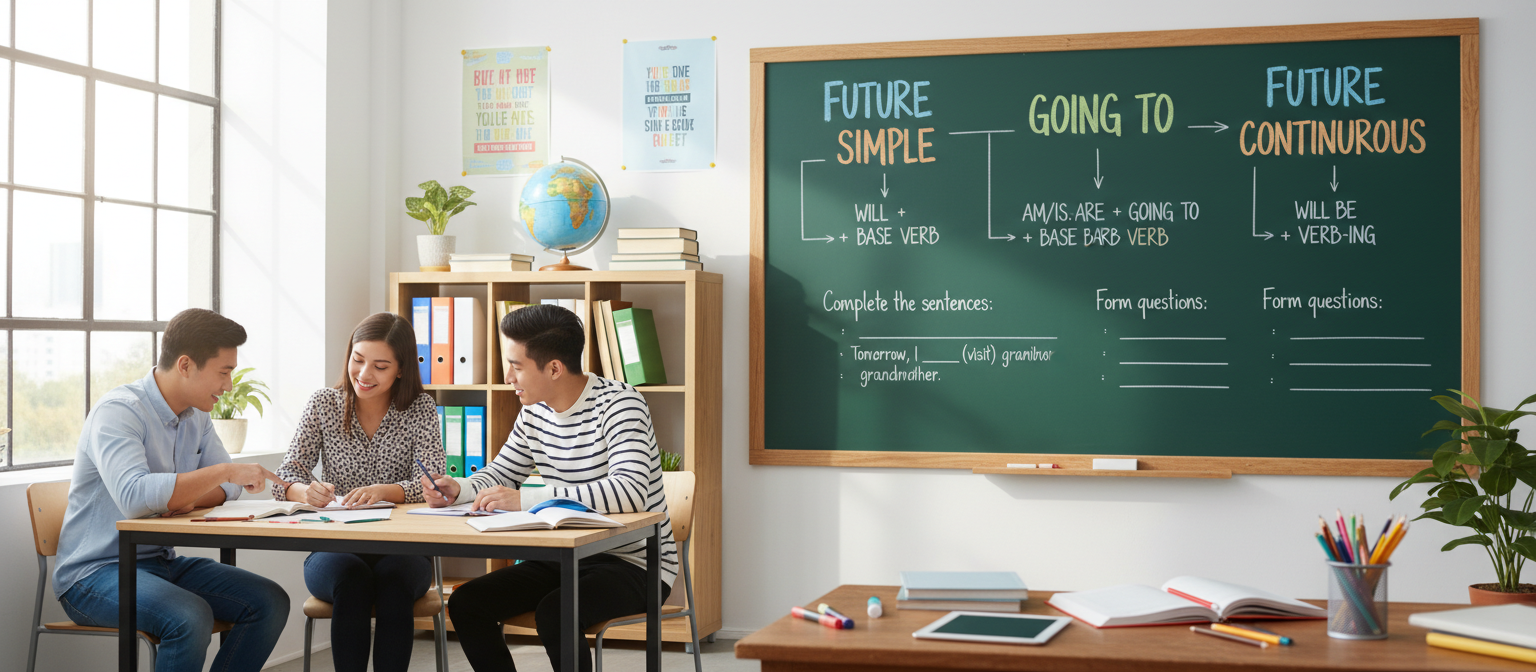
This page offers a workbook for learning future tenses. It covers three main English grammar forms: will, be going to, and Future Continuous. You’ll find short explanations, examples, and quick checks to help you.
It’s perfect for ESL learners from A1 to C1. Beginners learn simple rules and common patterns. More advanced learners get detailed notes on how to use these forms correctly.

The exercises aim to help you choose the right form for the meaning. You’ll practice with different scenarios, like making decisions, seeing evidence, planning, and actions in progress.
Key Takeaways
- Use future tenses exercises to link grammar to meaning, not just form.
- These future tenses exercises with answers include guidance and later answer verification.
- Future Simple exercises focus on decisions, offers, promises, and opinion-based predictions.
- Going to exercises focus on prior intentions and predictions based on evidence.
- Future Continuous exercises focus on actions in progress at a future time and polite questions.
- The tutorial supports English grammar future forms from A1–B1, with extra nuance notes for B2–C1.
Introduction to future tenses in English
English has many ways to talk about the future. We use different patterns for plans, predictions, and scheduled events. The choice of tense depends on what we want to say, not just when it happens.
Learning about future tenses gets easier when we link each form to a specific situation. Plans, quick offers, or timetables guide our grammar choices. This helps us use the future tense correctly in everyday conversations and writing.
Why learning future forms improves fluency and accuracy
Using the right future forms makes our speech clearer. It helps listeners understand us better without confusion. This makes plans sound organised, offers seem natural, and predictions seem well thought out.
Small changes in grammar can change the meaning a lot. Will often feels spontaneous, while be going to shows a decision made earlier. In questions, the Future Continuous can be more polite, avoiding pressure.
Common learner difficulties with future meaning
Many learners use will for all future ideas, even when a plan is set. They also mix up predictions based on opinion with those based on evidence. This affects their performance in speaking tests and workplace conversations.
Form-related issues are common too. These include missing will or be, wrong word order in questions, and subject–verb agreement errors. Time clauses can also cause problems, especially after when, after, and before. These are practical points of English future tense meaning that learners can notice and fix with guided practice.
-------- Continua após a publicidade --------
When to use Future Simple with will
In everyday English, Future Simple will use is strongest when the speaker reacts in real time. It often appears in short replies, customer service, and quick problem-solving. The form is simple, but the meaning is not: it signals a fresh choice, a stance, or a commitment.
Instant decisions, offers, and promises
Choose will when the decision is made at the moment of speaking, not planned earlier. A useful classroom check is to listen for a trigger: a new fact, a request, or a problem that needs a fast response.
Common patterns include will for offers (“I’ll carry that”), will for promises (“I’ll call you tonight”), and refusals (“I won’t tell anyone”). In service English, requests also fit: “Will you open the window?” These are social moves, not just grammar choices.
- Prompt: “The phone’s ringing.” Response: “I’ll get it.”
- Prompt: “This bag is heavy.” Response: “I’ll help you.”
- Prompt: “Please don’t share this.” Response: “I won’t say a word.”
Predictions based on opinion
Use will for beliefs and opinions, not for evidence you can see now. In will predictions, the speaker is guessing from experience, general knowledge, or personal judgement.
Signal words often appear near the verb: “I think”, “I’m sure”, “probably”, “definitely”, or “I doubt”. These markers help learners spot that the speaker is estimating, not observing.
- “I think it will be busy later.”
- “She’ll probably agree.”
- “I doubt they’ll change their minds.”
Key time expressions often used with will
Many future simple time expressions work smoothly with will, especially when the sentence is a quick response or a prediction. Typical choices include “tomorrow”, “next week”, “soon”, “in a minute”, “later”, and “one day”.
Time words alone do not choose the tense. The meaning does. A sentence with “tomorrow” can still be a plan (often going to) or a decision made now (often will), so learners should check intention and evidence.
| Communicative goal | Best fit with will | Typical cue in the situation | Example |
|---|---|---|---|
| Instant decision | Future Simple will use for a choice made now | New information appears | “There’s no milk. I’ll buy some.” |
| Supportive offer | will for offers | Someone needs help | “I’ll carry that for you.” |
| Commitment | will for promises | Reassurance is needed | “I’ll call you tonight.” |
| Opinion-based forecast | will predictions | Speaker judgement, not visible proof | “I’m sure it will work out.” |
| Time reference | future simple time expressions used for timing, not grammar choice | Words like “soon” or “later” | “I’ll do it later.” |
Practice Section (Answer Key at the end of the article)
- Choose the best response: “The doorbell is ringing.” → Write one sentence using Future Simple will use.
- Write one sentence that shows will for offers in a workplace or shop context.
- Rewrite with a promise: “I can meet you at 7.” → Make it will for promises.
- Add a time marker and keep the meaning: write one sentence with will predictions plus one of these future simple time expressions: “next week” or “one day”.
Future Simple structure and spelling rules
The Future Simple form is a clean way to talk about the future. It uses a short helper verb and a base verb. This keeps spelling stable.
In this unit, learners learn about will grammar structure. They then see how it changes in negatives and will questions. The main verb does not change, even with he, she, or it.
Affirmative, negative, and question forms
For statements, use this pattern: Subject + will + base verb. For example: She will arrive at 6.
For negatives, use this pattern: Subject + will not + base verb or the won’t contraction. For example: They won’t agree.
For will questions, use this pattern: Will + subject + base verb…? For example: Will you join us?
| Purpose | Form | Correct example | Spelling check |
|---|---|---|---|
| Affirmative | Subject + will + base verb | I will email the report today. | Base verb only: email, not emails or emailed |
| Negative | Subject + will not / won’t + base verb | We won’t change the booking. | Keep the base verb: change stays the same |
| Question | Will + subject + base verb? | Will they call before they arrive? | Word order matters; base verb stays plain: call |
Short answers and contractions in written English
Short answers match the helper verb, not the main verb. For example: Yes, I will. / No, I won’t. This keeps the will grammar structure clear and avoids extra words.
Contractions are common in messages and informal notes: I’ll, you’ll, he’ll, she’ll, we’ll, they’ll. In formal writing, learners should expand them to I will and will not, while keeping the Future Simple form unchanged.
Exercises with answers for Future Simple (will)
These Future Simple exercises with answers focus on quick choices, promises, and opinions. They help learners check meaning, form, and word order. These tasks are perfect for a phone screen or a quick classroom session.
Gap-fill: choose will / won’t
Rewrite: turn statements into questions and negatives
For will questions practice, rewrite each sentence as (a) a yes/no question and (b) a negative with won’t or will not.
- You will finish the report today. 1a) *Will you finish the report today*? 1b) *You won’t finish the report today*.
- They will be home by eight. 2a) *Will they be home by eight*? 2b) *They won’t be home by eight*.
- She will help with the tickets. 3a) *Will she help with the tickets*? 3b) *She won’t help with the tickets*.
- Short answer model: Will she help with the tickets? Yes, she will. No, she won’t.
Error correction: spot and fix mistakes
Mini dialogue practice: offers and promises
Use will to respond. This offers and promises practice highlights decisions made at the moment of speaking.
| Situation | Write the reply with will | Possible answer |
|---|---|---|
| “My phone battery is dead.” | Make an offer. | I’ll lend you my charger. |
| “This bag is too heavy.” | Make an offer. | I’ll carry it for you. |
| “Can you email the file today?” | Make a promise. | Yes, I’ll send it this afternoon. |
| “Please don’t be late again.” | Make a promise. | I won’t be late again. |
These Future Simple exercises with answers help learners practice form and purpose. They focus on quick decisions, clear negatives, and natural replies. These replies sound polite and direct.
When to use be going to for future plans
In everyday English, learners often use one form to show a plan already in place. This makes future plans feel personal and real, not sudden. A quick check works well: was the decision made before the speaker talked?
Intentions decided before speaking
Use be going to for going to intentions that exist before the moment of speaking. The choice is not made on the spot; it is already in the mind. This is the clearest will vs going to difference for many learners.
Examples for study and daily life:
- I’m going to revise this evening.
- We’re going to visit Boston at the weekend.
- She’s going to start a new course next month.
Predictions based on evidence
Use be going to for evidence predictions going to happen, where there is a clear sign now. The speaker reacts to what they can see, hear, or read on a screen. This meaning is different from a guess based only on opinion.
- Look at those dark clouds. It’s going to rain.
- That chair is leaning. It’s going to fall.
- My iPhone is on 1%. It’s going to shut down.
Typical contexts and time markers
Time markers often appear with going to future plans, because plans sit on a timeline. Common ones include this evening, tomorrow, next month, at the weekend, and in two days. They support meaning, but they do not replace the plan-or-evidence test.
| Meaning | Best choice | Quick test | Useful time markers |
|---|---|---|---|
| Plan already decided | be going to | Was it decided before speaking? | this evening; tomorrow; next month |
| Personal intention | be going to | Is the speaker committed already? | at the weekend; in two days; tonight |
| Prediction from present evidence | be going to | Is there a clear sign right now? | soon; in a minute; any moment |
| Opinion-based prediction | will | Is it mainly a guess or belief? | one day; in the future; later |
Practice Section
- Choose the better form: “I’m tired. I ___ have an early night.” Write going to or will.
- Write one sentence about your going to intentions for tomorrow using tomorrow or this evening.
- Look at this clue: “Battery 2%”. Write one evidence predictions going to sentence.
- Explain in one short line the will vs going to difference in this pair: “I’ll help you” vs “I’m going to help you”.
Be going to form and pronunciation tips
The going to form is clear for talking about plans and strong evidence. It uses the verb be plus going to plus a base verb. This means the main verb never gets an -s. Getting this pattern right makes speaking smoother and writing more precise.

Affirmative, negative, and question forms
Learners must control the be verb first. Then, keep the next verb in base form. Remember, to goes with going to, not the main verb.
| Meaning | Structure | Example |
|---|---|---|
| Affirmative plan | Subject + am/is/are + going to + base verb | I am going to email the teacher. |
| Negative plan | Subject + am/is/are not + going to + base verb | They are not going to drive tonight. |
| Question | Am/Is/Are + subject + going to + base verb…? | Are you going to study after dinner? |
For quick checks, focus on am is are going to choices first. This helps with going to questions too, where the word order changes but the base verb stays the same.
Common spoken reductions and how to write them correctly
In fast conversation, many speakers say gonna instead of going to. This is a listening issue first. The gonna pronunciation often blends with the next verb, especially before /k/ and /g/ sounds.
In writing, always use the standard spelling going to. Use it in homework, exams, emails, and workplace messages, even if you say it differently out loud.
- He’s gonna call later. → He’s going to call later.
- I’m gonna start now. → I’m going to start now.
As you practice Future Simple, Going to, and Future Continuous, it is also important to understand how native speakers talk about the future in everyday conversations. One of the most common informal forms is gonna, which is frequently used instead of going to in spoken English. If you want to improve your listening skills and sound more natural, be sure to check out our complete guide on Gonna, Wanna, and Gotta in English.
Exercises with answers for going to
These exercises focus on clear form, meaning, and quick checking. Keep sentences short. Listen for the link in speech between going and to. Write your answers first; self-check comes later in the key.
Choose the correct form: am/is/are going to
This practice targets subject–verb agreement.
- 1) I (am / is / are) going to cook pasta tonight.
- 2) The students (am / is / are) going to take the test on Friday.
- 3) My phone (am / is / are) going to run out of battery.
- 4) (Am / Is / Are) you going to visit family this weekend?
Picture-based prompts: predictions from evidence
Sentence building: make plans and intentions
Mixed correction task: will vs going to
When to use Future Continuous
Future Continuous use is great for talking about what’s happening at a future time. It focuses on the middle of an activity, not the start or end. The key form is will be -ing, which makes time clear for readers everywhere.
Actions in progress at a future time
Use the Future Continuous when a future action is already happening at a set time. Think of it as a time window: at that point, the action is already underway. This is useful for timetables, travel, and shifts.
Example: This time tomorrow, she’ll be flying to Chicago. At 3 p.m. on Friday, they’ll be meeting the client.
In future continuous vs will, the difference is often the focus. Will can sound like a simple fact or decision, while will be -ing shows an activity in motion during that time frame.
Polite questions about someone’s plans
Future Continuous for polite questions is common in offices and shared households. It sounds softer than a direct request, because it asks about a schedule rather than pushing for a favour.
Example: Will you be using the car later? Will you be joining the call at 10?
This Future Continuous use often suggests the speaker believes the plan may already be arranged. It also avoids pressure, which is why teachers often present it as future continuous vs will in practical speaking lessons.
Background actions vs shorter future events
Future Continuous can set the background, while a shorter event happens inside it. This helps with planning, storytelling, and “what happens when” talk. It also keeps the timeline easy to follow.
Example: I’ll be working at 8, so I won’t answer the phone. They’ll be driving home when the storm arrives.
| Communicative goal | Best choice | Model sentence | What it implies |
|---|---|---|---|
| Describe a future action in progress at a specific time | will be -ing | At noon, the team will be presenting the quarterly figures. | The action is ongoing during that time window. |
| Ask about plans without sounding demanding | Future Continuous for polite questions | Will you be staying late tonight? | The plan may already exist; the question feels less direct. |
| Show a longer activity as the setting for a shorter event | Future Continuous use | She will be cooking when the delivery arrives. | One action forms the background; another interrupts or fits into it. |
| State a quick decision or promise | future continuous vs will | I will call you after the meeting. | Focus is on the decision or promise, not an activity in progress. |
Practice
- Complete: At 7 p.m. tonight, I ________ (watch) the match.
- Choose the more polite option: “Will you use the printer?” or “Will you be using the printer?”
- Match the ideas: background action + short event. Write one sentence using will be -ing + “when”.
- Rewrite to change the focus (future continuous vs will): “I will work at 8” → make it sound like an action in progress.
Future Continuous form and usage notes
The Future Continuous form is used to talk about actions happening at a specific time in the future. It’s great for talking about plans, asking polite questions, and describing background actions in stories.

Affirmative, negative, and question forms
The core structure of the Future Continuous form is straightforward. It remains the same for all subjects. This makes it easy to understand, even in complex sentences.
| Form | Pattern | Example | Common use |
|---|---|---|---|
| Affirmative | Subject + will be + verb-ing | I will be working at 7 pm. | Action in progress at a future time |
| Negative | Subject + won’t be + verb-ing | They won’t be travelling next week. | Stopping an expected activity |
| Question | Will + subject + be + verb-ing…? | Will you be using the meeting room later? | Polite enquiry about plans |
| Short answer | Yes/No + subject + will/won’t | Yes, I will. / No, I won’t. | Quick replies to Future Continuous questions |
Spelling is key with the -ing form. You might see changes like make → making and run → running. Always check the base verb before writing.
Time clauses and common adverbials
Adverbials like this time tomorrow, at 7 pm, in two hours, and next week fit well with the Future Continuous tense. They help pin down the action to a specific point in time.
Time clauses often use a present form to show future meaning. For example, When you arrive, I’ll be waiting. This sounds more natural than using will in both parts.
Stative verbs and why some verbs sound odd in continuous
Stative verbs describe states, not actions. Using them in the Future Continuous form can sound odd because states are not usually in progress. Examples include know, believe, belong, need, and like.
For stative verbs, learners usually prefer a simple form over the Future Continuous. For instance, I’ll know tomorrow sounds natural, while I’ll be knowing tomorrow does not.
Some verbs can change meaning, making the continuous form possible in certain situations. Learners should test the sentence. If it describes an activity, the Future Continuous form often fits. If it describes a fixed state, a simple form is usually better.
Future tenses exercises
This set of exercises tests real understanding, not just memorisation. Learners are asked to read the meaning first, then choose the correct form for the situation.
Before each item, underline the clue word or idea. This could be something like “Look at those clouds” or “I haven’t decided yet”. It helps learners focus on the right tense, rather than guessing.
Mixed practice: will, going to, and Future Continuous
Context clues: choosing the best future form
This is a quick future tense worksheet: one best answer each time.
Rewrite practice: change tense without changing meaning
Short reading: identify and explain each future tense
Read the paragraph, then complete the tasks. This future tense reading exercise checks form and reason.
It’s Monday, and the office is busy. At 10 am tomorrow, the team will be presenting the new figures on Zoom. The report is finished, so the manager is going to send it this afternoon. Someone knocks at the door, and the receptionist says, “I’ll get that.” Later, a colleague asks, “Will you be staying late tonight?” Dark clouds gather outside; it’s going to rain before the commute.
- Underline each future form and label it: will, be going to, or Future Continuous.
- Next to each one, write the reason: instant decision, plan, evidence-based prediction, action in progress, or polite enquiry.
Answer key and explanations
Use this key to check meaning, not just form. Each answer includes a short label, so learners can link choice to context. For extra practice of future tenses exercises answers, compare your reasoning with the labels before marking.
Answers for will exercises with brief reasoning
- The teacher will arrive shortly. (timetable-style prediction)
- The programme will continue for some time now. (opinion prediction)
- The cat will be meowing a lot after the vaccine. (prediction from experience)
- I will be reading it for some time. (planned reading period; note: this is future continuous, not a basic will decision)
- We will paint our bedroom next month. (decision stated; in many contexts going to also fits if already planned)
- My brother will be waiting for me. (Future Continuous set-up)
- I will be returning home next week. (arrangement stated; could be going to if emphasising a plan)
- Fred will visit us soon. (simple prediction)
- It will be Christmas next week. (fact-based future)
- Tom will have completed the chore by then. (future perfect: completion before a deadline)
When marking will exercises answers, treat “will” as strongest for a fresh response, promise, or speaker judgement. If a learner chose going to in items 5 or 7, accept it only when they clearly describe a pre-decided plan.
Answers for going to exercises with brief reasoning
- I am going to speak to the teacher after class. (pre-decided intention; be agreement: I am)
- She is going to apply for the job tonight. (plan; be agreement: she is)
- They are going to meet at 6 p.m. (arrangement signal; be agreement: they are)
- Look at those clouds. It is going to rain. (prediction from evidence; be agreement: it is)
In going to exercises answers, check the first verb first: am/is/are. Most errors are not about meaning, but agreement, especially with it and plural subjects.
Answers for Future Continuous exercises with brief reasoning
- When I reach home, my dog will be waiting on the porch. (in progress at future time)
- The bride will be waiting for the groom. (background action)
- Will you be using the car tonight? (polite enquiry)
- At 8 o’clock, I will be working. (in progress at future time)
For Future Continuous answers, avoid stative verbs in continuous forms. If a learner writes “I will be knowing”, the preferred option is “I will know” or “I will find out”, depending on meaning.
Answers for mixed future tense practice
- I will go to my sister’s house tomorrow. (simple future: decision/promise tone)
- Amy will deliver a lecture on neutrons. (simple future: scheduled public event phrased as will)
- Rumi shall have completed his task by then. (future perfect: deadline clue “by then”)
- Miss Smith will have been teaching for twelve years coming May. (future perfect continuous: duration up to a point)
- The flight will arrive at 3:30 a.m. (timetable point)
- They will have left for Kashmir by next day. (future perfect: finished before a time)
- Mom will have cooked my favourite pasta. (future perfect: completed before a later moment)
- Shelly will have been practising Spanish for an hour when you arrive. (future perfect continuous: duration + “when” time cue)
- The guests will arrive shortly. (near-future prediction)
- By next spring, the workers will have completed the bridge. (future perfect: “by” deadline)
- Sam will have taken a holiday by next week. (future perfect: completion before next week ends)
- The sun will rise tomorrow at 8 o’clock. (fact/timetable-style statement)
This set of future tenses exercises answers is easiest to mark by spotting the time clue first: by often points to future perfect, and a stated time point often supports Future Continuous answers. Keep future tense explanations short and tied to the label, so learners can self-correct fast.
For additional grammar reference, you can consult the Cambridge English Grammar section.
| Form | Fast clue to look for | Label used in this key | Typical learner fix |
|---|---|---|---|
| will + base verb | speaker decision, judgement, quick response | instant decision / opinion prediction / promise | Do not add to after will; use base verb only |
| am/is/are going to + base verb | plan already decided; evidence you can see now | pre-decided intention / prediction from evidence | Check be agreement before anything else |
| will be + -ing | action in progress at a future time; polite question | in progress at future time / polite enquiry | Avoid stative verbs; switch to simple future where needed |
| will have + past participle | completed before a future deadline | deadline completion | Use past participle, not past simple |
Conclusion
This summary covers the main rules for the future tense. It helps with future tense revision. Use will for instant decisions, offers, promises, or predictions. Use be going to for planned actions or predictions with evidence.
For actions in progress or polite questions, use Future Continuous. This makes your English grammar better.
Study in short, spaced sessions. Do the future tense practice again after 48 hours. Check the answers. Read a short text aloud and mark where the tense changes the meaning.
Then, write three versions of a personal plan. Use will, be going to, and Future Continuous. This helps you see the difference in tone and focus.
In class, use mixed tasks for quick future tense checks. The answer key helps with feedback. This way, learners focus on meaning, not just memorising.
When learners can explain why a form is used, they do better in speaking and writing. Next, focus on areas where errors often happen. This could be form, question order, or meaning choice.
Once you’ve mastered these, move on to more advanced future forms. The Future Perfect is a good next step in a separate lesson.
FAQ
What is the main difference between will and be going to for future meaning?
Will is used for quick decisions, offers, promises, or opinions (like “I think it’ll be fine”). Be going to is for plans made before speaking or predictions based on current evidence (like “Look at those clouds. It’s going to rain”).
Can time expressions like “tomorrow” or “next week” decide which future tense to use?
No, not by themselves. Words like tomorrow, soon, later, at the weekend, and next month can go with different future tenses. The right choice depends on the context, like timing, evidence, plans, or ongoing actions.
How is the Future Continuous different from will?
The Future Continuous (will be + -ing) talks about ongoing actions in the future (like “This time tomorrow, she’ll be flying”). It’s also used for polite questions about plans, making it sound less direct than will (like “Will you be using the car later?”).
Should learners use will after when, after, or before in time clauses?
In many cases, the time clause uses a present form, even for future times: “When you arrive, I’ll be waiting.” The time clause is in the present, and the main clause has the future meaning. This avoids a common mistake in future tense grammar.
Is “gonna” correct for writing going to in English exercises?
Gonna is a common spoken reduction in informal speech. But in formal writing, it’s safer to use going to. Make sure the verb be matches the subject: “I am going to…”, “She is going to…”, “They are going to…”.