

Introduction
Understanding Prepositions In On At can be challenging for beginner English learners. In this lesson, you will learn how to use these essential prepositions with real examples inspired by the FIFA World Cup schedule. Through practical exercises and interactive activities, you will improve your grammar while exploring one of the biggest sporting events in the world.
Prepositions are small words, but they play a very important role in communication. They help us talk about places, dates, and times accurately. Many English learners struggle to decide whether they should use in, on, or at, especially when discussing schedules and events.
The FIFA World Cup provides a perfect real-life context for practicing these prepositions. By using match schedules, cities, countries, dates, and times, you will learn how English speakers naturally use IN, ON, and AT in everyday situations.
What Are Prepositions?
Prepositions are words that show relationships between other words in a sentence. They often indicate time, location, or direction.
| Preposition | Main Use | Example |
|---|---|---|
| IN | Months, years, countries, cities | I live in Brazil. |
| ON | Days and dates | The game is on Monday. |
| AT | Time | The match starts at 8 p.m. |
Learning these three prepositions is one of the first steps toward mastering English grammar.
Understanding IN
We use IN for countries, cities, months, years, and larger places.
Examples
I live in Brazil.
(Eu moro no Brasil.)
The tournament will be in Canada.
(O torneio será no Canadá.)
-------- Continua após a publicidade --------
More examples:
- My cousin lives in Mexico.
- The World Cup will be held in North America.
- The final match will take place in July.
Understanding ON
We use ON for specific days and dates.
Examples
My English class is on Tuesday.
(Minha aula de inglês é na terça-feira.)
The match is on June 15th.
(O jogo é em 15 de junho.)
More examples:
- The game is on Friday.
- Brazil plays on June 11th.
- The opening ceremony is on Sunday.
Understanding AT
We use AT for specific times.
Examples
The lesson starts at 7:00 p.m.
(A aula começa às 19h.)
The game begins at 9:00 p.m.
(O jogo começa às 21h.)
More examples:
- The match starts at 8 p.m.
- The players arrive at 6:30 p.m.
- The ceremony begins at noon.
This section is a great location for a Google AdSense block.
How to Use IN, ON, and AT with the World Cup Schedule
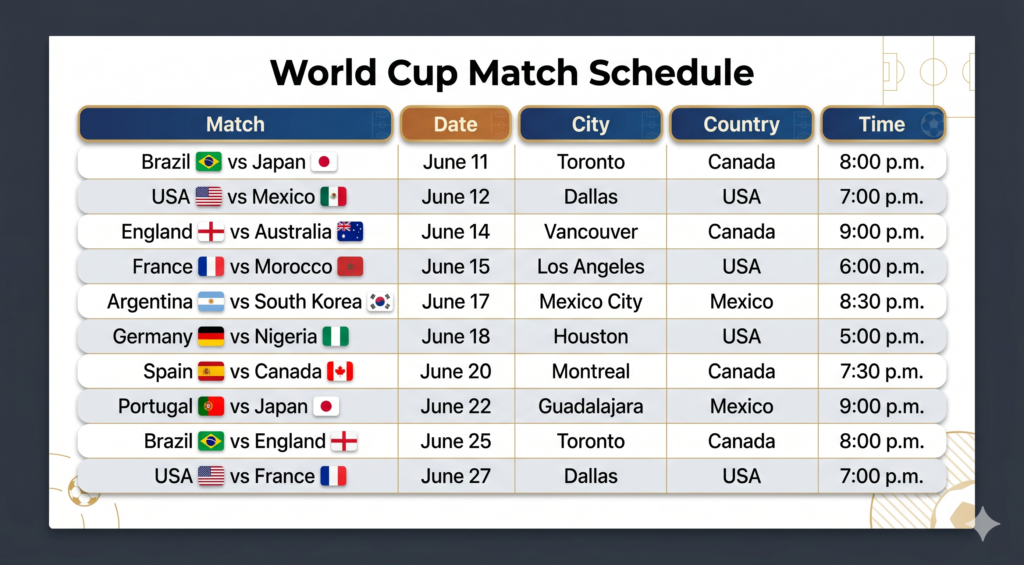
Let’s use a World Cup schedule to see how these prepositions work together.
Example
Brazil vs Japan is on June 11th, in Toronto, in Canada, at 8:00 p.m.
Notice how we use:
- ON + date
- IN + city
- IN + country
- AT + time
This pattern works for all World Cup matches.
Practice Section: Complete the Sentences
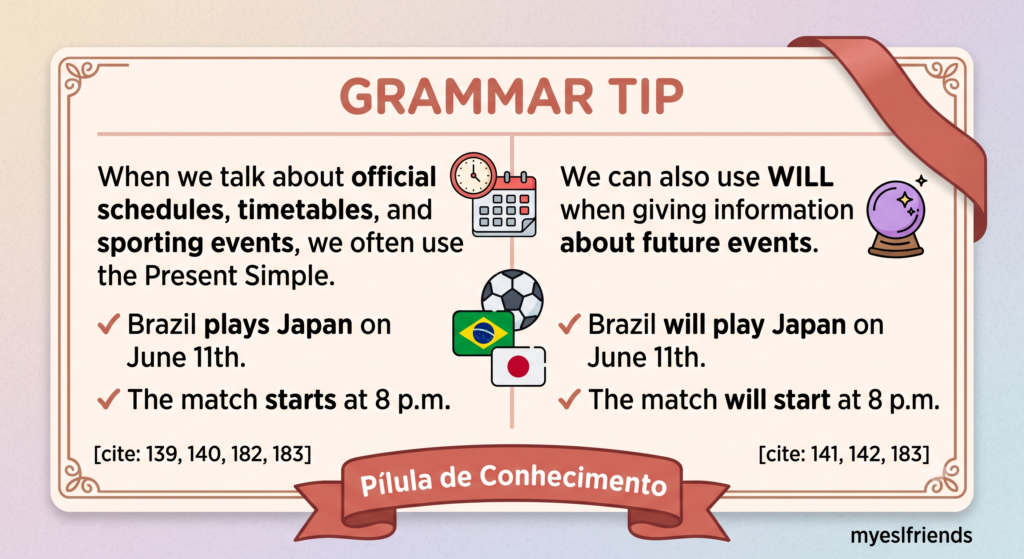
Knowledge Pill: Talking About Future Schedules
Learn more:
These grammar structures are very common in sports news, travel schedules, and event calendars.
Answer the Questions – Fill in the Blanks
Fill in the Blanks
Match the Information (Drag and Drop)
Speaking Practice
Work with a partner and answer the questions.
- Which World Cup match would you most like to watch?
- What matches are on your birthday?
- What games are in your favorite city?
- What match starts at the best time for you?
- Which country will win the World Cup?
- Would you like to watch a match in Canada, Mexico, or the USA? Why?
- What is your favorite national team?
- Have you ever watched a World Cup match live?
Writing Practice
Write five sentences using IN, ON, and AT.
Example: Brazil will play in Toronto on June 11th at 8:00 p.m.
Write your own sentences:
- _______________________________________________________________________________________________
- _______________________________________________________________________________________________
- _______________________________________________________________________________________________
- _______________________________________________________________________________________________
- _______________________________________________________________________________________________
Challenge
Write three more sentences about your favorite team using:
- IN + city/country
- ON + date/day
- AT + time
Teacher Notes
Suggested Level
A1–A2
Grammar Focus
Prepositions of Time and Place:
- IN
- ON
- AT
Skills Practiced
- Reading
- Grammar
- Speaking
- Writing
- Critical Thinking
Classroom Use
This lesson can be used for:
- Online lessons
- Private classes
- Conversation classes
- ESL group classes
- Homework assignments
- Sports-themed lessons
- FIFA World Cup projects
Estimated Lesson Time
45–60 minutes
Extension Activity
Ask students to create their own World Cup schedule and write sentences using:
- IN
- ON
- AT
Students can then exchange schedules and ask questions using:
- When…?
- Where…?
- What time…?
Teacher Resource Available!
Want a printable version of this lesson? Download our free PDF workbook designed for ESL teachers and students. It includes grammar explanations, practice activities, speaking tasks, writing exercises, and an answer key ready for classroom use or homework assignments.
Download here the free PDF.
Perfect for A1–A2 learners, conversation classes, online lessons, and World Cup-themed English activities.
Conclusion
Congratulations!
You have learned how to use three of the most important English prepositions:
- IN → cities, countries, months, years
- ON → days and dates
- AT → specific times
Using a real FIFA World Cup schedule makes grammar more meaningful and easier to remember. By connecting English to authentic events, you can see how these prepositions are used in everyday communication.
Keep practicing by reading sports schedules, travel itineraries, and event calendars in English.
Your Turn!
Which World Cup match would you most like to watch?
Write your answer in the comments using IN, ON, and AT.
Example:
I would like to watch Brazil vs England in Toronto on June 25th at 8:00 p.m.
FAQs
How can I teach prepositions in a fun way?
Using authentic contexts such as sports schedules, travel plans, and real-world events helps students understand prepositions naturally and improves retention.
What are the best ESL activities for teaching IN, ON, and AT?
Gap-fill exercises, schedule analysis, drag-and-drop activities, speaking tasks, and information-gap exercises are highly effective for beginner learners.
How do I use sports topics to teach English grammar?
Sports schedules provide natural examples of dates, locations, and times, making them perfect for practicing grammar topics like prepositions and future schedules.
Are World Cup activities effective for beginner English learners?
Yes. The World Cup is a familiar topic that increases engagement and motivation while providing authentic language examples.
Where can teachers find free ESL worksheets about prepositions?
Teachers can find free resources, lesson plans, and interactive activities on MyESLFriends, including materials focused on grammar, vocabulary, speaking, and listening skills.




2 thoughts on “Prepositions In On At: Learn English with the FIFA World Cup Schedule Activities (A2) (Free PDF)”