

Introduction
Knowing how to ask for and give directions is an important communication skill in English. Students use this language when traveling, visiting new places, or helping tourists.
In this lesson, Giving Directions, A2 learners will practice vocabulary, grammar, speaking, and reading skills through interactive activities, maps, and practical exercises.
To give accurate directions, students should also understand prepositions of place, such as next to, between, and opposite. If your students need extra practice, check out our lesson on Prepositions of Place in English.
Learners also use the imperative form when giving directions. Expressions such as turn left and go straight ahead are examples of the imperative. You may also like our complete guide on The Imperative in English.
Essential Vocabulary | Vocabulário Essencial
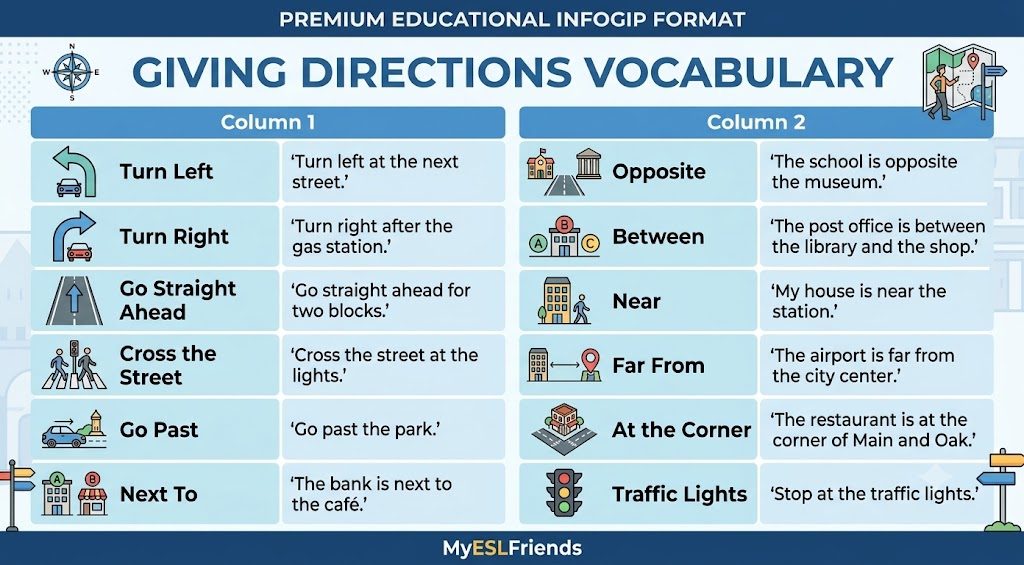
Asking for Directions | Pedindo Informações
Students often use the following questions:
- Excuse me, where is the museum?
- How can I get to the train station?
- Is there a pharmacy near here?
- Could you tell me how to get to the movie theater?
- Which way is the supermarket?
Sample Dialogue
Tourist: Excuse me, how can I get to the museum?
Local: Go straight ahead for two blocks. Turn right at Maple Avenue. The museum is next to the library.
Tourist: Thank you!
Local: You’re welcome.
-------- Continua após a publicidade --------
Giving Directions | Dando Direções
Useful expressions:
- Go straight ahead.
- Turn left at the traffic lights.
- Turn right at the corner.
- Cross the street.
- Go past the supermarket.
- It’s next to the library.
- It’s opposite the hospital.
- It’s between the bakery and the pharmacy.
According to the Cambridge Dictionary, go straight ahead means to continue moving forward without changing direction.
Grammar Focus: TO vs FROM
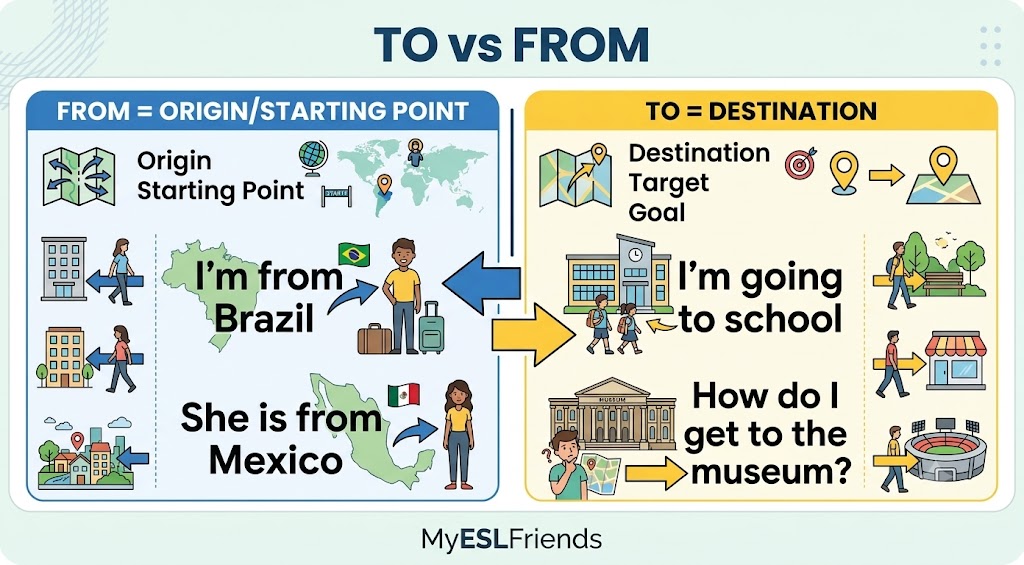
Many students confuse to and from.
TO = destination
Examples:
- I’m going to the cinema.
- How do I get to the hospital?
FROM = origin or starting point
Examples:
- I’m from Brazil.
- She is from Argentina.
Nas frases acima, from indica origem.
Também usamos from para indicar ponto de partida.
Examples:
- Walk from the station to the museum.
- Go from the supermarket to the hospital.
Remember
FROM → origem
TO → destino
Interactive City Map Activity
Remember:
⭐ YOU ARE HERE: BUS STATION
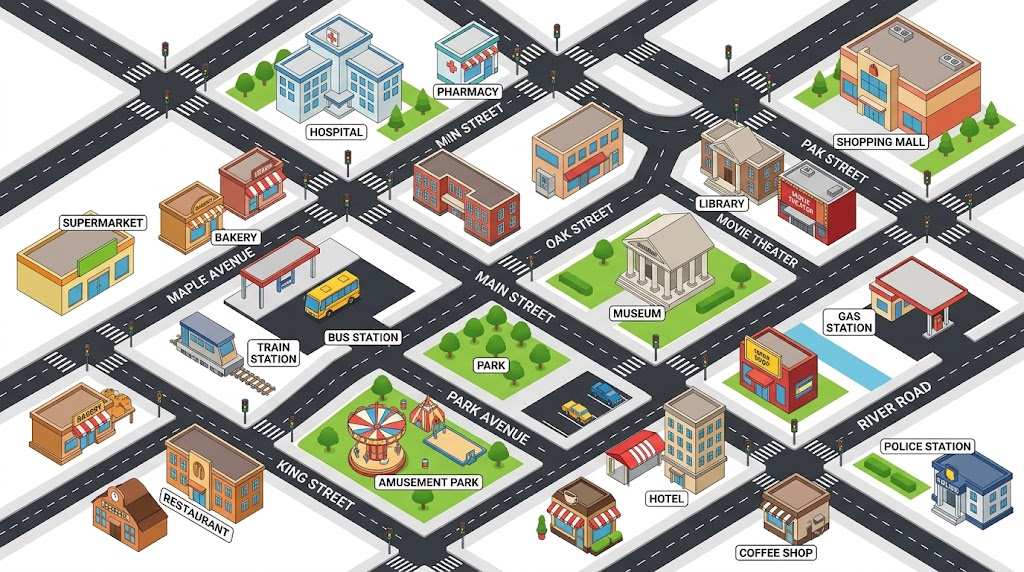
Look at the city map and answer the questions.
Exercise 1 – Reading the Map
- Where is the museum?
- What place is near the hospital?l?
- Is the bakery next to the pharmacy?
- What places are on Main Street?
- Is the movie theater near the park?
Exercise 2 – Giving Directions
Use the map.
- How do you get from the Bus Station to the Museum?
- How do you get from the Bus Station to the Movie Theater?
- How do you get from the Bus Station to the Hospital?
- How do you get from the Bus Station to the Shopping Mall?
Exercise 3 – Write the Directions
Use the map.
- From the Park to the Museum.
- From the Gas Station to the Library.
- From the Train Station to the Hospital.
- From the Amusement Park to the Pharmacy.
Activity 1 – Fill in the Blanks
H5P Activity 2 – Drag the Words
H5P Activity 3 – True or False
Read the sentences, look at the maps, and choose True or False.
Activity 4 – Speaking
Student A asks for directions.
Student B answers using the map.
Destinations:
- museum
- hospital
- movie theater
- amusement park
- shopping mall
Creative Activity – Be a Tourist!
Imagine you are visiting New York City.
You are at Times Square.
Ask for directions to:
- Central Park
- The Metropolitan Museum of Art
- Grand Central Terminal
Work with a partner.
External Practice
Students can practice additional listening activities on My England Blog and improve their learning.
Teacher’s Notes
Use:
- printed maps;
- digital maps;
- role-play;
- pair work;
- H5P activities;
- classroom treasure hunts.
You can also hide location cards around the classroom and ask students to give directions to find them.
Download Your Free PDF
Aprender giving directions é um passo importante para se comunicar com confiança em inglês, mas esse é apenas um dos muitos tópicos necessários para desenvolver fluência. Se você deseja evoluir de forma estruturada, com aulas organizadas e acompanhamento do seu progresso, vale a pena conhecer um curso completo de inglês online. Um bom curso reúne vocabulário, gramática, compreensão oral, conversação e situações reais do dia a dia, tornando o aprendizado mais eficiente. Confira o curso que recomendamos e descubra como acelerar sua jornada no inglês. 👉 [CLIQUE AQUI!]
Answer Key
Exercise 1
Answers will vary according to the map.
Exercise 2 (Suggested Answers)
- Go straight ahead on Main Street. Turn right on Oak Street. The museum is next to the library.
- Go straight ahead. Turn left at Maple Avenue. The movie theater is opposite the park.
- Go straight ahead and turn right at King Street. The hospital is next to the pharmacy.
- Walk along Main Street and turn left at Park Avenue. The shopping mall is on your right.
Exercise 3 (Suggested Answers)
Answers may vary.
Activity 1
- straight
- left
- next to
- opposite
- right
Activity 2
- pharmacy
- movie theater
- museum
- train station
- bakery
- park
Speaking Activity (Suggested Answers)
Students should use expressions such as:
- Go straight ahead.
- Turn left/right.
- Cross the street.
- It’s next to…
- It’s opposite…
- It’s between…
Conclusion
Learning how to ask for and give directions helps students communicate in real-life situations. Through maps, role-plays, interactive activities, and practical exercises, learners can develop confidence and improve their English communication skills.
FAQ
How do you ask for directions in English?
Common expressions include: How can I get to…?, Where is…? and Could you tell me how to get to…?
What expressions are used to give directions?
Students often use expressions such as turn left, turn right, go straight ahead, cross the street, and go past.
What is the difference between TO and FROM?
To indicates destination, while from indicates origin or starting point.
What are the most common places in a city vocabulary lesson?
Hospital, museum, supermarket, pharmacy, school, movie theater, park, library, and train station are common examples.
How can teachers teach giving directions?
Teachers can use maps, role-plays, games, H5P activities, worksheets, and pair work activities.
Which CEFR level is Giving Directions?
Giving Directions is usually taught at A1 and A2 levels.
Why is learning directions important in English?
Because students use this language in real-life situations such as traveling, tourism, and everyday communication.




1 thought on “Giving Directions in English (A2): Atividades, Exercícios H5P e PDF para ESL”