Introduction
September is an important month in Brazil. Known as Setembro Amarelo (Yellow September), the campaign promotes awareness about mental health and suicide prevention.
For English teachers, this topic can also become an opportunity to create meaningful lessons focused on communication, emotions, empathy, and support.
This Setembro Amarelo Lesson Plan was designed to help teachers approach the topic through English while developing the four essential language skills: listening, speaking, reading, and writing. You can find other helpful sazonal contents in our category Vocabulário Temático.
Important note: When working with sensitive topics, teachers should adapt the discussion to the students’ age and context. The objective of this lesson is language development, empathy, and awareness—not psychological counseling.
What Is Setembro Amarelo?
Setembro Amarelo is a Brazilian awareness campaign dedicated to suicide prevention and mental health awareness. During September, different organizations, schools, and communities promote conversations about emotional well-being, empathy, support, and the importance of seeking help when necessary.
In the English classroom, teachers can explore related vocabulary and communication strategies while encouraging respectful and meaningful discussions.
Instead of focusing on sensitive or distressing details, this lesson plan emphasizes positive and accessible topics such as:
- emotions and feelings;
- friendship;
- empathy;
- asking for help;
- offering support;
- kindness;
- self-care;
- positive communication.
This approach makes the topic more appropriate for the language classroom while still encouraging reflection.
💛 Setembro Amarelo – The Power of Kind Words
An English lesson about emotions, empathy, and supportive communication
-------- Continua após a publicidade --------
📋 1. Lesson Overview
| Field | Details |
| Level | A2–B1 |
| Age Group | Teens and Adults |
| Duration | 60–90 minutes |
| Main Skills | Listening, Speaking, Reading, Writing |
| Language Focus | Feelings vocabulary, empathy expressions, offering support |
| Objectives | By the end of the lesson, students will be able to talk about feelings, use expressions of empathy and support, and write a short positive message in English. |
🌤️ 2. Warm-Up: How Are You Feeling Today?
Teacher instructions: Write the question “How are you feeling today?” on the board. Elicit feelings vocabulary from students and write it on the board with simple drawings or emojis. Ask students to choose a word that describes how they feel and share it with a partner.
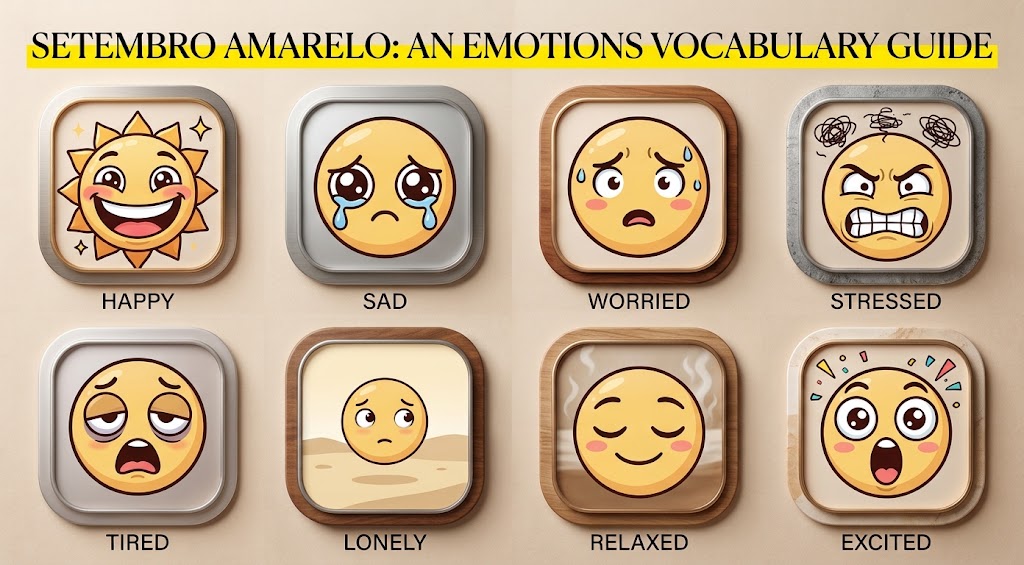
Discussion questions:
- How are you feeling today?
- What usually makes you feel happy?
- What do you do when you feel stressed?
- What activities help you relax?
Model answers:
- “I’m feeling relaxed today because it’s the weekend.”
- “Spending time with friends usually makes me feel happy.”
- “When I feel stressed, I listen to music.”
| 💬 Reminder: Students should never feel pressured to share personal experiences. Participation should always be voluntary and comfortable. |
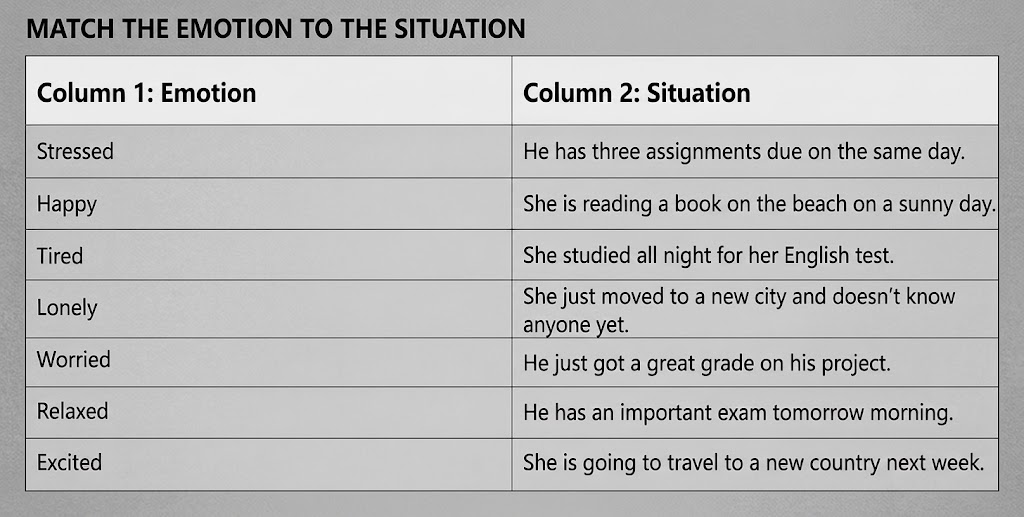
🧩 3. Vocabulary Activity — Match the Emotion to the Situation
Students match each emotion with the situation that best describes it.
📖 4. Reading Activity: The Power of Listening
| The Power of Listening Sometimes people don’t need advice. They just need someone to listen. Maria noticed that her classmate, Lucas, seemed quiet and tired during class. At lunchtime, she sat next to him and asked, “Are you okay? You seem a little stressed today.” Lucas smiled softly and said he had a lot of schoolwork and felt overwhelmed. Maria didn’t try to fix everything. She simply said, “That sounds difficult. I’m here to listen if you want to talk.” They talked for a few minutes, and Lucas felt better. Small moments of kindness can make a big difference. A simple question, a kind word, or a few minutes of attention can help someone feel less alone. Listening is a powerful way to show we care. |
Reading Comprehension
Multiple Choice — circle the correct answer:
- How did Lucas feel during class? a) excited b) tired and stressed c) angry
- What did Maria do first? a) She gave him advice. b) She asked if he was okay. c) She ignored him.
- What helped Lucas feel better? a) A test result b) Talking with Maria c) Going home early
True or False:
- Maria immediately tried to solve all of Lucas’s problems. (____)
- Listening can help someone feel less alone. (____)
| ✅ Answer Key: 1) b 2) b 3) b 4) False 5) True |
🎧 5. Listening Activity: A Supportive Conversation
| Ana: Hey, are you okay? You look worried today. Bruno: Not really. I have so much homework this week, and I have a test on Friday. Ana: I’m sorry to hear that. That sounds difficult. Bruno: Yeah, I’m feeling really stressed. Ana: Do you want to talk about it? I’m here to listen. Bruno: Thanks, Ana. That means a lot. Ana: Remember, you are not alone. Maybe you should make a study schedule for the week. Bruno: That’s a good idea. Thank you for caring. |
Listening Comprehension Questions
- How is Bruno feeling?
- Why does he feel this way?
- What does Ana offer to do?
- What advice does Ana give?
Fill in the Blanks (H5P-ready)
| Ana: Hey, are you _______? You look worried today. Bruno: Not really. I have so much homework, and I have a test on Friday. Ana: I’m _______ to hear that. That sounds _______. Ana: Do you want to _______ about it? I’m here to _______. Ana: Remember, you are not _______. |
| ✅ Answer Key: okay, sorry, difficult, talk, listen, alone |
🗣️ 6. Speaking Activity: Supportive Conversations
Teacher instructions: Divide students into pairs. Give each pair a situation card. Student A shares the situation, and Student B responds using supportive language from the box below. Then switch roles.
Situation Cards
| # | Situation |
| 1 | You feel nervous about an exam tomorrow. |
| 2 | You have too many assignments this week. |
| 3 | You feel tired after a difficult week. |
| 4 | You are moving to a new city and feel nervous. |
| 5 | You are preparing for an important presentation. |
| 6 | You feel a little lonely after starting a new school. |
| Showing Empathy: I understand. / That sounds difficult. / I’m sorry to hear that. Offering Support: Are you okay? / Do you want to talk? / I’m here to listen. Giving Simple Advice: Maybe you should… / Why don’t you…? |
✍️ 7. Writing Activity: A Message of Kindness
Write a short positive message (4–6 sentences) for a friend who is having a difficult week. Use at least two sentence starters below.
| Remember that… You are not alone because… Sometimes it’s okay to… A good friend can… One thing that makes life better is… |
Model text:
| Hi! I know this week has been hard for you. Remember that it’s okay to feel tired sometimes. You are not alone because your friends are here for you. A good friend can always listen without judging. One thing that makes life better is knowing someone cares. Sending you a big smile today! 😊 |
👥 8. Group Project: The Power of Kind Words
In small groups, students create a poster or digital presentation titled “The Power of Kind Words.” Each group must include:
- Five positive expressions in English
- Three ways to support a friend
- Vocabulary related to emotions
- One inspirational message
Presentation instructions: Each group presents their poster to the class in English (2–3 minutes). Encourage clear speaking and eye contact. Other students can ask one supportive question after each presentation.
🎯 9. Four Skills Development
| Skill | How it’s developed |
| Listening | Students listen to a supportive dialogue and answer comprehension questions. |
| Speaking | Students practice empathy and support in pair conversations using situation cards. |
| Reading | Students read a short story and answer comprehension questions. |
| Writing | Students write a short positive message using target vocabulary and structures. |
📝 10. Teacher’s Notes
| • Adapt the vocabulary and situations to match your students’ age and context. • Create a respectful, non-judgmental classroom environment before starting. • Never pressure students to share personal experiences — all sharing should be optional. • Keep the focus on English communication skills, not therapy or counseling. • Encourage positive, respectful interaction throughout every activity. |
🌟 11. Final Reflection
| Why is listening important? How can kind words make a difference? What makes someone a good friend? How can we show empathy? |
Conclusion
Teaching English also means teaching communication.
A Setembro Amarelo Lesson Plan can provide an opportunity to explore vocabulary and language functions while encouraging kindness, empathy, and respectful communication.
The most important objective is to create a safe and appropriate learning environment where students can practice English through meaningful interactions.
Simple questions such as “How are you?” and expressions such as “I’m here to listen” may become valuable language tools—not only inside the classroom but also in everyday life.
Explore More English Teaching Resources
Looking for more creative and practical ideas for your English classes?
Explore the lesson plans, activities, games, and teaching resources available at MyESLFriends Home Page and discover new ways to make English lessons more engaging, interactive, and meaningful.
If you ar looking for advanced materials, visit our other web site myenglandblog.
MyESLFriends Community • myeslfriends.com.br
FAQs
1. What is Setembro Amarelo?
Setembro Amarelo is a Brazilian awareness campaign focused on suicide prevention and mental health awareness. During September, different initiatives encourage conversations about emotional well-being, empathy, and seeking appropriate support.
2. Can I teach Setembro Amarelo in an English class?
Yes. English teachers can approach the topic through vocabulary, communication, empathy, emotions, and supportive language. Activities should always be adapted to students’ age and context.
3. Which English level is appropriate for this lesson?
This lesson works particularly well with A2–B1 students, but vocabulary and tasks can be simplified or expanded for other levels.
4. How can I use H5P with the topic Yelow September?
You can create interactive activities such as drag-and-drop vocabulary exercises, listening gap-fills, reading quizzes, pronunciation activities, and interactive books.
5. How can I approach sensitive topics safely in class?
Focus on language learning, empathy, kindness, communication, and general well-being. Avoid pressuring students to share personal experiences and remember that teachers are not expected to provide psychological counseling.
© MyESLFriends.com.br — All rights reserved. For personal and classroom use only. Redistribution, resale, reproduction or commercial use of this material, in whole or in part, is strictly prohibited without prior written permission.